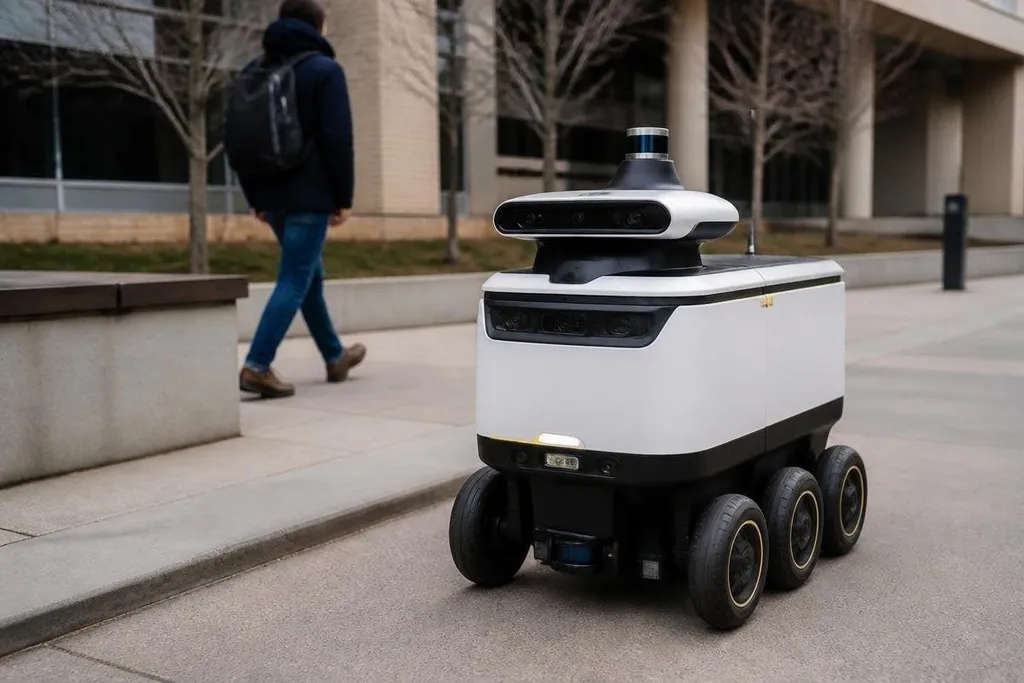
Radar lets a robot detect objects by sending out radio waves and measuring the signals that return. That gives an autonomous system information about distance, movement, and shape, even when a camera has a poor view.
- Radar can detect objects in darkness, dust, and light rain.
- The sensor measures range from the return time of a radio signal.
- Radar works best when its data is combined with cameras, LiDAR, or other sensors.
What radar measures
A radar sensor sends radio energy into the space around the robot. When that energy meets an object, part of it returns to the sensor. Its software uses the delay between transmission and return to estimate how far away the object is.
A second measurement comes from frequency change. If an object moves toward the robot, the returned signal shifts one way. If it moves away, the shift goes the other way. This effect, called Doppler shift, helps the robot estimate motion.
The sensor can also compare signals received by several antennas. That lets the robot estimate an object's direction and, in some systems, its angle above or below the sensor. The result is a stream of range and motion data that software can use while the robot moves.
Radar doesn't create a camera-like image. It gives the robot points, reflections, and movement clues. Software combines those clues into a map or a short-term view of nearby objects.
Why robots use radar
Radio waves can pass through conditions that trouble visible-light cameras. Darkness has no effect on the radio signal, and dust or light rain may reduce the signal less than they reduce a camera image. Radar can also keep detecting a moving object when glare makes visual data hard to read.
That matters to a mobile robot working outside, in a warehouse, or near a road. A delivery robot may use radar to detect a person or vehicle ahead. A warehouse robot may use it to watch for moving equipment near an aisle.
The exact result depends on the sensor, software, object, and surrounding surfaces. Radar also uses less visual detail than a camera, so it leaves the robot with less information about color, text, or a person's identity. A radar return may show that something occupies a space without telling the robot what that thing is.
Radar claims matter most when a machine has to work around people and moving equipment. Robot24.com robotics reports can show where companies use radar in vehicles and warehouses before we look at the sensor's limits.
Radar has real limits
Small objects can return weak signals. Flat surfaces may reflect radio energy away from the sensor, while metal can create strong returns that hide nearby objects. Multiple reflections can also make one object appear in the wrong place.
Radar data needs software that can reject noise and connect separate measurements over time. A mobile system may track a moving object by comparing its position across several sensor updates. That tracking can fail when objects move close together or disappear behind a larger object.
Radar doesn't replace other sensors. Cameras add color and fine visual detail. LiDAR measures distance with laser light and can produce a more detailed 3D view. Wheel encoders and inertial sensors tell the robot how its own body has moved. The control system combines these inputs so one weak reading doesn't decide the robot's action alone.
I'd choose radar as part of a sensor set, not as the only way a robot sees.
How radar data guides movement
At each update, the system first checks which returns belong to nearby objects. It then estimates each object's position and speed, compares that information with its planned route, and decides whether to continue, slow down, or stop.
This process runs again as the robot moves. A parked object may need one response, while a moving person needs repeated updates. The robot's safety rules also matter: detection alone doesn't tell the system how close it may safely get or how quickly it must stop.
Radar placement affects the result. A sensor mounted low may see barriers near the floor but miss objects higher up. A sensor mounted high may cover more distance while missing a small object close to the robot. The mounting angle, field of view, and blind spots belong in the robot's test plan.
A practical radar checklist
Before adding radar to a robot, check these points:
- Define the task: decide whether the robot needs distance, motion, direction, or all three.
- List the conditions: include darkness, dust, rain, glare, reflective surfaces, and crowded spaces.
- Map blind spots: record where the sensor cannot see because of its mount or housing.
- Pair the data: decide which camera, LiDAR, encoder, or inertial readings will support radar.
- Test moving objects: measure how the system reacts when people, vehicles, or equipment cross its route.
That checklist keeps the sensor choice tied to the job. Radar is useful when a robot needs distance and motion data in conditions that can weaken a camera, but the full system still depends on placement, software, and the other sensors around it.
The practical question is narrow: what must this robot detect, and what conditions will make that task hard? Answer that before choosing the radar.